
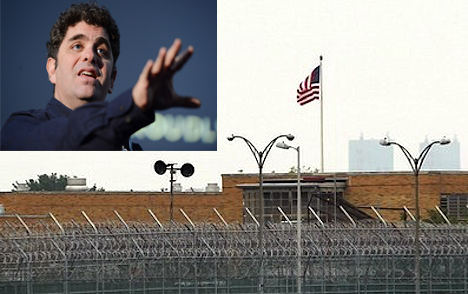
It seems about right that it’s raining as we drive over the bridge to Rikers Island in a prison van with metal grills over the windows. We’re riding with Eugene Jarecki, the director and writer of The House I Live In—this year’s Sundance-winning, Oscar-shortlisted documentary examining the cruel grip of America’s War on Drugs. A screening for prisoners is taking place at New York City’s vast jail complex—an establishment that drug laws feed well.
Jarecki is a curly-haired ball of energy in the back of the van. With his characteristic rapid delivery, he relates how a female prison worker once told him she had her cheekbone smashed by one of her charges: “…but within 30 seconds of her story starting,” he says, “she switches to this glowing account of the two other inmates that stepped in to protect her.” Jarecki, who is 43, is nervous “in a nice way” about this screening of The House I Live In. “I shot it in prisons,” he says. “I owe it to those people whose images I shot to bring it back to them.”
The 20-year mandatory minimum sentence handed out to one young, nonviolent drug offender—despite the judge’s admission that he doesn’t deserve such a punishment—draws audible reactions and shaking of heads from the watching prisoners.
But his mission goes far beyond that payback. He believes that in the current political climate, the estimated $1 trillion spent on the war on drugs to-date makes ending it—and drug prohibition itself—feasible. “We’re at a moment where this thing is vulnerable,” he says, “because the morality is meeting fiscal conservatism.” His film has been making headlines as well as earning a reputation inside the system it criticizes; reactions at his 10 previous prison screenings, mainly in Oklahoma and California, have inspired him, and his team is fielding requests from facilities around the country that welcome the debate. He reels off a list of upcoming venues, including some resonant names: San Quentin, Sing Sing, Angola. He expects many more to follow: “I can see it being shown at 200 prisons over the next two years.”
Raised in well-heeled Connecticut and New York, Jarecki might not seem an obvious spokesman for the poor and imprisoned. But his Jewish parents, having fled Europe (his father left Nazi Germany as a child in 1939), placed a high value on speaking out for the persecuted. His work includes The Trials of Henry Kissinger (2002), Why We Fight (2005), and the ultra-short Move Your Money (2010); his brother Andrew, also a filmmaker, made Capturing the Friedmans (2003). “Growing up in the wake of the civil rights movement,” says Jarecki, “we were taught to have a fundamental sensitivity to that…and high hopes for what that movement would produce.” His hopes were largely disappointed, and he later connected the “decay” he saw in the black community and beyond with Richard Nixon’s 1971 declaration of a “War on Drugs.” Defining his work as part of “the fight for social justice,” he states that “there is not one threat to that cause greater than modern industrial capitalism and its drive to put profit before people.” He calls out the health industry and the military-industrial complex, but identifies “for-profit industrialized incarceration,” which “runs on human fuel,” as the worst offender of all.
Leaving the van, we go through ID checks, scanners and ultraviolet hand stamps. Jarecki, who casually acknowledges that he has addictions, including one to eating—”Who among us doesn’t?”—says he feels “an incredible wave of freedom rush over me” because of the need to leave his iPhone behind for once. We’re shown into a dingy gym with a giant movie screen unfurled at one end. Linda Eaddy, director of community partnerships, is with us; she’s worked at Rikers for 26 years, 11 of them as a substance abuse counselor. A minimum of 12,000 prisoners are held here at any one time, she tells us as we wait: 82% are “detainees” (not yet sentenced) and the rest are serving sentences of under one year. Around 100,000 prisoners pass through the complex annually. So what does she think about the drug laws and sentences that send them there? “In my position, I have no opinion on that,” she replies.
Jarecki and the handful of activists and filmmakers with him are told that the audience for the screening will consist entirely of “adolescents”—prisoners aged 16-18, who are housed separately. But when the gym doors open, some older men hobble in, using canes and crutches. They’re followed by more adults in green overalls; the teenagers, wearing khaki, enter last and occupy a few rows at the front. That’s three generations.
The film begins. It’s immediately clear how hard it can be to achieve focus on the inside: booted footsteps, shouts, clattering gates and the crackling of guards’ radios compete for attention. Light reflecting off the screen obscures some images. The men lounge nonchalantly, yawning, talking to neighbors and eyeing up the guests. Soon though, most seem to be pulled in.
It took Jarecki four years to film his documentary across more than 20 states. The result is a kaleidoscopic array of interview subjects: law enforcement and corrections officers, journalists, a judge, names like Dr. Gabor Maté and David Simon, creator of The Wire, and most powerfully, some of the victims of the war on drugs—young men facing long prison sentences, a mother who lost her son, a nonviolent lifer without parole. Revelations like the 20-year mandatory minimum sentence handed out to one young, nonviolent drug offender—despite the powerless judge’s admission that he doesn’t deserve such a punishment—draw audible reactions and shaking of heads from the watching prisoners.
As reviewers agree (The House I Live In currently has a 96% critics’ rating on Rotten Tomatoes), the movie successfully lands its punches against America’s drug-law regime. But reality takes over at Rikers: Jarecki is told that an impending prisoners’ count means he must stop the film early.
It’s a shame we don’t make it to the end; it’s the most important part of the film, tying the threads of the previous 90 minutes in a cogent critique of the real thrust of the war on drugs, who profits from it, and who suffers. One of the best contributions is from historian Richard Lawrence Miller, who supplies a measured and therefore devastating comparison of the prosecution of this war with the persecution of other population groups, in other times and places.
With time running out, Jarecki embarks on a frantic Q&A. The men hesitate at first, but soon pile in with views and questions. “I can’t believe there is a war on drugs—it’s more a war on low-income communities,” says one prisoner, echoing one of the film’s conclusions. “You have a voice, and your family does,” Jarecki tells him. “It’s up to all of us to represent the persecuted poor.”
“Can you share some of the real impact you’ve had?” asks a second man. Jarecki tells him about the screenings arranged in Washington and Colorado prior to their votes to legalize marijuana, and the use of his film as part of the successful campaign for California’s Proposition 36, softening that state’s notorious “three strikes” law—the director says that many tweets and messages told him that The House I Live In “changed my vote.”
“I appreciate you coming in and shedding light on this situation,” says another inmate. “You really hit it on the nose. To a couple of brothers in here, if you don’t know about the Jim Crow laws…well, what’s changed?” Jarecki agrees: “Just look how many people in this room are black, to put it bluntly,” he says. “Black people are 13% of this country; they’re 90% of the people in this room.”
“The reason why 80-90% in this room are people of color,” says another man, “is that when they send the SWAT cars out, they send them to black project housing.”
“Right,” says Jarecki. “I live in a white area—I can’t even find a cop when I need one.” Cue laughter.
The mood changes when the filmmaker addresses poverty (a key theme; at one stage The House I Live In even had the short-lived working title of The War on Poverty). Emphasizing the overwhelming prevalence of poor people in America’s criminal justice system—and including the prison guards present as members of “the working poor”—Jarecki declares, to an audible response, “I am not a poor person. I’m looking at you: I can tell you are poor people, just by the fact that you are in this room.”
Afterwards, as everyone begins to file out, two prisoners make a point of telling me they took offense at being labeled this way: “I don’t like that part; I’m not poor,” complains one middle-aged man, who concedes the wider point that “90% of the people in here are poor.” When I put this to Jarecki later, he says, “I’ve never felt a bad reaction to that before. I feel like I need to tell them that I’m not poor when I say it, so they don’t feel bullshitted. They should be angry—though not at me. Nobody likes to identify themselves as poor, but to make the point that the poor are being targeted by the system, I have to take the risk that somebody may be offended.”
Most of the prisoners react more positively. Sam Mazatio, 32, from the Bronx, likes the points the movie makes about the crack and powder cocaine sentencing disparity—which used to be set at a 100-1 ratio and has now been “reformed” to 18-1. He’s currently serving 45 days for crack possession: “I got lucky,” he says. “They downgraded my charge.” He calls the film “beautiful” and name-checks Julie Stewart, the founder of Families Against Mandatory Minimums, for a contribution that “really broke it down.”
“We need to convince the American people out of the dogma. It comes down to a bit of a word game. The word ‘legalization’ scares Americans—they think of Night of the Living Dead, zombies on every corner…”
Thomas Hartmann, a 43-year-old man on crutches, is near the end of a six-month sentence for assault. He praises the film’s treatment of the origins of America’s opium, marijuana and cocaine prohibitions as ways of targeting Chinese, Mexican and African American populations respectively: “I wonder if [alcohol] Prohibition was because of the Irish?” David Ekukupe from the Bronx adds, “I like that the movie reached out to every crowd; it speaks to everyone.” Serving a sentence for robbery, he’s 18 and looks it.
Jarecki has mixed feelings as we drive away: frustration that his film had to be cut off, but conviction that the audience still gained from it. He may be appalled by an “obscene” system that locks up 500,000 nonviolent drug offenders among 2.3 million people in total—making Americans less likely to be at liberty than the citizens of any other country on earth—but he doesn’t blame the people who work in prisons. “There are knuckle-dragging neanderthals in every field, certainly in corrections,” he says. “But that’s not the headline for me.” Instead he’s heard corrections staff all over the country telling him that they don’t like the system, that it isn’t working. “But there is this attitude of, ‘What can I do about it? This is my job.’ It’s a very ‘aww shucks’ American spirit.”
Such encounters leave him optimistic that the war on drugs will end—eventually. “When you have this big a loser on your hands, it’s hard to stand by it. Politicians used to run on it; now they won’t even mention it…But you have to force politicians to be compelled to comment.” He implores Obama not to derail states’ progress towards better drug laws; the President apparently has a copy of The House I Live In and is due to watch it.
So how should we go about reform? “Portugal is a big help to us,” says Jarecki, citing that country’s example of decriminalizing all drugs, treating their use as a health issue rather than a criminal one, and cutting rates of addiction and HIV in the process. Does he prefer to push Portuguese-style decriminalization then, rather than the kind of full legalization that would see street drugs sold in pharmacies? He makes a face. “We need incremental efforts to convince the American people out of the dogma, the Kool-Aid they drank in the Reagan era. It comes down to a bit of a word game. The word ‘legalization’ scares Americans—they think of Night of the Living Dead, zombies on every corner…The alternative is just to take drugs out of the criminal system.”
He seizes on a word that he thinks can be a game-changer: “‘Regulation’ is the smartest of all—legalization with a reminder to the public that the government is staying involved.” It’s illegal for a child to consume alcohol, he elaborates, and while it’s legal for adults to drink, committing crimes while under the influence means that the law views you as additionally culpable. Equivalent safeguards, presented in the right way, could offer reassurance on other drugs. “Let’s take what we do with alcohol,” he says, “and devote a fraction of the [tax] proceeds to developing a robust treatment system.”
Jarecki sees advocacy as his primary mission: “I only make films so I can get on John Stewart and talk common sense for five minutes.” He talks of the publicity boost that Brad Pitt gave The House I Live In by coming on board as an executive producer (and chuckles about a National Enquirer story last month that claimed Pitt’s attendance at a screening was linked to the imminent demise of “Brangelina.”)
Ralph Nader once told Jarecki that he made great films but didn’t necessarily “deploy” them very well; he took that to heart. As well as those campaigns in California, Washington and Colorado, this film is being used in aid of causes such as ending stop-and-frisk in New York. (“White people must have more complicated pocket systems or something,” quips Jarecki of cops’ racially-distorted drug seizures.) Many more screenings are planned around the country; you can find out about them at the movie’s website.
Jarecki will need all of his obvious determination: Lawmakers in the US and elsewhere are gradually recognizing the need for change, but progress often seems agonizingly slow—and that’s to those of us who aren’t languishing in jail. He relates a Japanese parable that he says sustains him. It’s about a boy throwing pebbles into a lake. The boy sees ripples each time, but then nothing more. He expresses to his grandfather his disappointment that nothing changes. But the level of the lake rises, his grandfather points out, even if you can’t see it: “But still it rises.”
“That phrase might as well be tattooed on my brain,” says Jarecki.
Will Godfrey is Managing Editor of The Fix.