
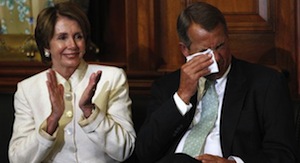
Five days before Christmas, House Speaker John Boehner stood before the Republican-controlled Congress—his Plan B alternative for avoiding the fiscal cliff defeated by lack of votes from his own party, a public humiliation and repudiation of the Speaker’s authority, rare in House history. Choking back tears, Boehner faced his colleagues and surrendered himself to a Higher Authority: “God, grant me the serenity to accept the things I cannot change, the courage to change the things I can, and the wisdom to know the difference,” Boehner intoned.
The Serenity Prayer was an odd choice for a guy whose drinking had drawn years of public and private scrutiny (there’s even a blog called DrunkBoehner dedicated to chronicling his meltdowns).
For Boehner watchers—and sympathizers—it was a hushed “Amen Brother” moment. The Ohio kid who had grown up in his father’s bar, an admitted chain smoker (Camel Ultra Lights), a suspected tanning-bed addict (he insists his orange countenance, the butt of media jokes, is from golfing and mowing the lawn), a guy who tips back the merlot and is a frequent crier, seemed to have come full circle in his personal narrative of struggle, redemption and self-awareness. To any 12-step member, Boehner’s Serenity Prayer moment suggested more than a passing familiarity with the program. (The media didn’t dwell on this inference.)
The fiscal cliff negotiations were never going to go Boehner’s way and neither were the Republican newcomers who put up the most resistance. An old-school party leader, he had performed in the time-honored manner, offering compromises and cutting deals behind closed doors. But even the whiff of raising taxes was too much for the Tea Party-backed ideologues, those meddlesome freshmen from the class of 2010, whom Boehner had done his best to appease, cajole and discipline. A week after his desperate prayer, the 63-year-old Speaker was forced to stand by as a final budget deal was dictated not by the House, but by Senate GOP leader Mitch McConnell. Boehner dutifully voted in favor, while most other Republicans, including Boehner’s no. 2, Eric Cantor of Virginia, widely viewed as scheming for Boehner’s job, and Whip Kevin McCarthy, a leader of the conservative Young Guns, voted no. Following the Plan B embarrassment, this was surely a bitter chaser for the veteran lawmaker to swallow. Somewhere in between, Politico reported that Boehner had turned on the old barroom charm, jabbing a finger at Senate Majority Leader Harry Reid, a Democrat, and said, “Go fuck yourself.”
“After 5 or 6 at night, he is disengaged at best. You can see him at bars.”
These tackles by his own team were even more bruising because they took place in the days immediately before he stood for re-election as House Speaker. Would he be ignominiously routed? was a breathless media story. In the end, Boehner got to keep his job—not in a show of party unity, but in one of the most contentious votes in modern House history. A record 12 Republicans refused to support him. Boehner had the title but not the loyalty. And with it he inherits a world of trouble.
Almost since he became House Speaker two years ago Boehner has had a tough time wielding his gavel. It doesn’t help that he gets weepy on big occasions. “I wear my emotions on my sleeve,” he once told Fox News, defending himself against critics who said it made him look “weak” or “strange.” It also doesn’t help, particularly for a leader caught up in the nation’s healthcare debate, that at the age of 63 he hasn’t kicked the smokes. When CBS’ Bob Schieffer, a former smoker and cancer survivor, confronted him on the topic in 2010 (noting that the tobacco industry had given Boehner $340,000 in campaign contributions), Boehner turned evangelical. “Bob, tobacco is a legal product in America,” he said. “And the American people have the right to decide for themselves whether they want to partake or not.” He then turned morose, saying, “Well, listen, I wish I didn’t have this bad habit and it is a bad habit…But it’s something that I choose to do. And, you know, at some point, maybe I’ll decide I’ve had enough of it.”Sounds like magical thinking, as familiar to anyone in recovery as denial and rationalization: I choose to do it. But I’ll quit some day. When I want to. A lot has been made of Boehner’s nicotine addiction as well as his impulsive public weeping. Is it depression? Stress? An undiagnosed infection? Is he merely a man in touch with his own feelings? Or is it something else? Alcohol of course does reduce inhibitions and you’re more likely to weep when you’ve had a few or when the full misery of the hangover hits. He’s made no secret of his taste for merlot (reportedly Markham from Napa Valley). He frequents the Capitol Hill Club and is a regular at a DC Italian restaurant where he is often seen drinking wine. When Obama quipped at a holiday party that he had seen Boehner drinking eggnog, Boehner shot back, “I was drinking wine.” Ed Schultz, the liberal MSNBC host, once jokingly called Boehner a “cheap drunk.” The speculation is not confined to lefties. Schultz’s colleague, Joe Scarborough, a former Republican congressman, has noted that “so many Republicans tell me this is a guy that is not the hardest worker in the world. After 5 o’clock, 6 o’clock at night, he is disengaged at best. You can see him around town…you can see him at bars.”
No one with any credibility has come out and said that Boehner is an alcoholic. The Fix contacted a large number of politicians, former colleagues and opponents for input, including former Speaker Dennis Hastert, outspoken freshman Republican Representatives Steve Sutherland of Florida and Patrick McHenry of North Carolina, even well-known Republican pollster and message strategist Frank Luntz, but none wanted to speak on the subject. But all these jokes and allusions are dancing around the topic. And there are plenty of people who admire Boehner for having the courage of his transgressions. Unlike President Obama, who never wanted to be photographed smoking before he finally quit in August, Boehner has smoked and sipped his wine in public. He also doesn’t hide his crying, which in other realms of public and private life is reason for enlightened praise. Feminists have come to his defense, asking why the double standard over crying?
Boehner has consistently swatted away the worst speculation and criticism about his appetites. But in contrast to his party’s Young Guns—as the three conservatives nipping at his heels, Cantor, McCarthy and Paul Ryan, the House Budget Committee Chairman, dubbed themselves in a 2010 book-cum-manifesto of the same name—he is sorely behind these sobered up times. The book alludes to the weakness of the old guard, of which Boehner is a major figure, noting, “We lost our way when we were in the majority.” The authors distance themselves from that generation, by explaining, “We had a majority of people who came here to do something, and we atrophied into a majority of people who came here to be something.” Indeed, Ryan and his hardline followers favor P90X workouts and ripped abs over flabby sentimentality, some pledging to live like monks in their offices rather than waste taxpayer money on housing (the most coveted being the closest to the House gym.)
“I need this job like I need a hole in the head.”
By contrast, Boehner’s bad habits belong less to the current generation of legislators than to previous ones, when Senators got drunk in the bar above the Senate before casting votes on legislation and everyone knew who was the alcoholic and who the adulterer, but kept it secret until the DUI, car crash, diddling of congressional pages, swimming naked in the Sea of Galilee or in the Tidal Basin with a stripper. The new generation seems to be abstemious to a fault. (On the other hand, their private behavior may be driven by all the usual addictions and compulsions. Only time and the media will tell.) This generational difference, not only in lifestyle habits but in hardline political philosophy, is expected to be a growing source of conflict between Boehner and the feisty upstarts. “I need this job like I need a hole in the head,” Boehner told the Wall Street Journal last week.
As Congress lurches toward its next crisis—whether or not to raise the debt ceiling—Boehner will again be at the helm clutching his smokes like a cutlass. But with Obama saying he won’t negotiate on the need to raise it, the House Speaker will be in for another rough ride with his Republican bedfellows. And the pressure he is under from his own party, let alone the larger responsibilities of being Majority Leader, are likely only to increase his craving for the opiates, endorphins and other sedatives delivered by booze, cigs, UV rays and a good, old cry. Frequent resorting to the Serenity Prayer is probably also on, uh, tap.
Just last week, Boehner claimed he had Republican defense hawks in his “back pocket,” to use as leverage against Obama to avoid the automatic defense cuts that are set to go into effect if the two sides can’t agree to lower other spending. At least one, Representative Duncan Hunter, a Republican from California—a member of the Armed Services Committee whose district is home to one of the nation’s biggest military installations—shot back that Boehner was getting into “dangerous territory when you talk about using national security as a bargaining chip with the president.”
In his personal narrative, Boehner is fond of sharing the worldview he earned sweeping out his father’s Cincinnati bar as a kid (all 12 Boehner kids did the job at one time or another) and that seems to have shaped his entire life. “You have to learn to deal with every character that walks in the door,” Boehner said in 2010, explaining how he was prepared to handle the incoming freshmen.
But maybe it’s time to step out of the bar and get (back?) into the rooms.
Kevin Gray is a New York-based journalist. He writes about business, crime, politics and celebrity. He has reported from the Congo, Libya, Lebanon, Colombia, China and throughout the U.S. His work has appeared in The New York Times Magazine, New York, Details, People, Men’s Journal and the Washington Post.